TRENDING
Importance of Safety Standard in AMR: ISO 13849-1 & ISO 3691-4
In the rapidly evolving industrial automation landscape, ensuring worker safety remains a top priority. As Autonomous Mobile Robots (AMRs) gain widespread adoption in industrial environments, establishing robust safety standards becomes essential to reduce potential risks. This is where International Organization for Standardization (ISO) standards, such as ISO 13849-1 and ISO 3691-4, play a crucial role.
ISO 13849-1 provides a foundational framework for evaluating safety in machinery, with guidelines on designing and integrating safety-related components in control systems. It employs a systematic approach to assess the safety performance of equipment throughout its lifecycle, ensuring potential risks are effectively managed.
On the other hand, ISO 3691-4 addresses the specific safety requirements for driverless industrial trucks, which include AMRs. This standard details critical safety measures to ensure the reliable and hazard-free operation of AMRs in industrial environments.
Performance Levels (PL)
A key element of these standards is the Performance Level (PL) framework, introduced in ISO 13849-1. PL acts as a standardized benchmark for assessing the safety capabilities of machinery. Both ISO 13849-1 and ISO 3691-4 use PL to define the safety compliance requirements for AMRs, ensuring they meet necessary criteria to minimize risks in operational settings.
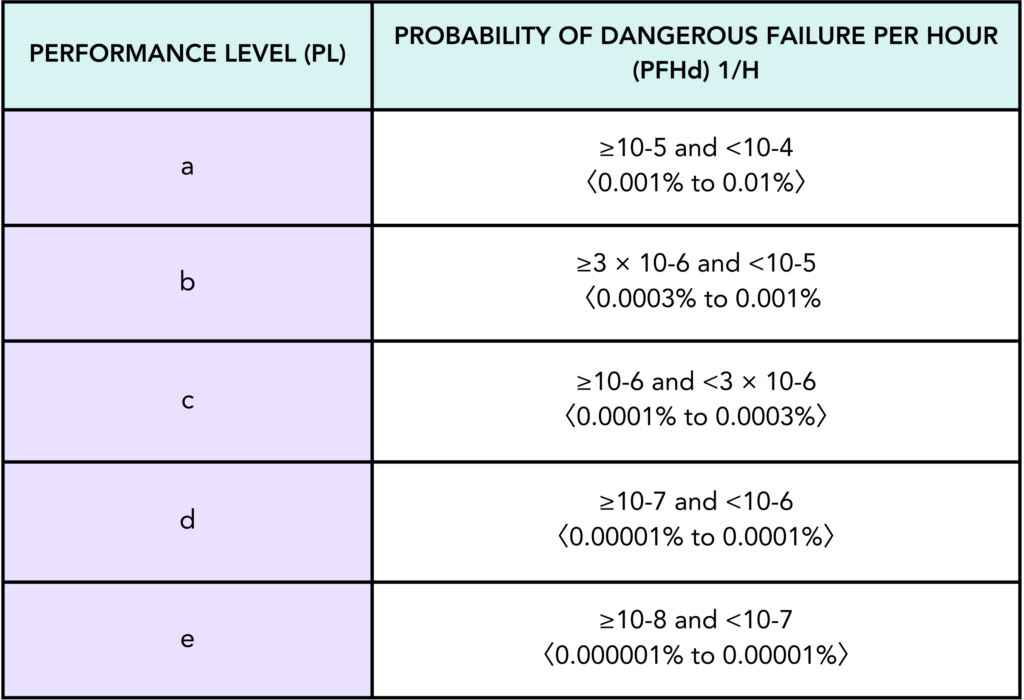
ISO 3691-4 specifies detailed safety protocols for various operational scenarios. For instance, strict speed control measures are mandated to regulate the movement of AMRs. Safety-critical components like encoders, motion monitors, and controllers must meet designated PL levels to ensure safe navigation and prevent accidents.
Obstacle detection is another critical area. AMRs must have reliable sensor systems capable of identifying hazards or personnel in their path. ISO 3691-4 assigns specific PL requirements to these safety functions, ensuring AMRs can detect and react promptly to obstacles in their environment. Additionally, the standard prescribes precise testing protocols to validate compliance and assess the effectiveness of implemented safety measures under real-world conditions.
ISO 13849-1 provides a foundational framework for evaluating safety in machinery, with guidelines on designing and integrating safety-related components in control systems. It employs a systematic approach to assess the safety performance of equipment throughout its lifecycle, ensuring potential risks are effectively managed.
Enhancing Safety with Robomate's Technology
At Robomate, we prioritize compliance with ISO standards and have integrated advanced safety features into our AMRs to meet these benchmarks. Here are two key systems enhancing safety in our robots:
- NavWiz Obstacle Sensing System
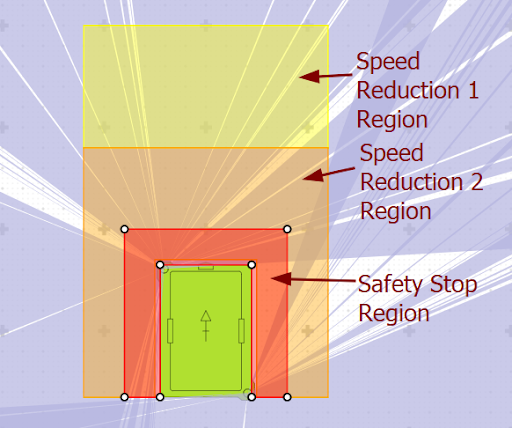
Our obstacle sensing system anticipates hazards using designated “Speed Reduction Zones” (Figure 2). Upon detecting obstacles, it automatically reduces the AMR’s speed to pre-configured levels, enabling safe navigation. If an obstacle is detected in the “Safety Stop Region,” the system triggers an immediate stop, ensuring maximum safety. - Safety Controller System
This system operates independently alongside the obstacle sensing system, continuously monitoring the AMR’s environment. If the AMR exceeds safe limits or rarely encounters an unforeseen issue, the safety controller intervenes. It triggers a forceful stop by cutting motor power, minimizing risks and ensuring compliance with safety standards.
Standards like ISO 13849-1 and ISO 3691-4 play a key role in ensuring AMR safety, offering comprehensive frameworks for risk mitigation and regulatory compliance. At Robomate, we are committed to not only meeting these standards but also pushing the boundaries of innovation in AMR safety. Our advanced systems seamlessly integrate into industrial settings, safeguarding workers while optimizing operational efficiency.
For inquiries about our solutions, feel free to contact us at sales@robomate.com